About Jack Reusch

This author has not yet filled in any details.
So far Jack Reusch has created 51 blog entries.

Tandem Drifting for beginners

Where should you actually be looking in tandem? Most people tell new drivers to watch the lead car’s front wheels in tandem. What's the problem with that you ask? Early on, that often causes chase drivers to dive too far inside and nearly pass the lead car. What we teach works much better: start by focusing on the rear quarter panel, just above the rear wheel. This helps newer drivers understand proper positioning and spacing during the first couple laps. [...]

By |2026-05-08T12:25:35-06:00May 8th, 2026|

Tandem Transitions

Transitions during tandem are where most drivers fall apart, but its also where the great drivers separate themselves. Most drivers can stay close in a corner just fine, but when it's time to transition, everything changes. One small mistake can cost you proximity, the whole run, or maybe even both cars. There’s a danger zone about the length of a car that exists through the entire transition. If you’re too close or too far inside, you’re putting yourself in a [...]

By |2026-05-08T12:25:10-06:00May 8th, 2026|

The Biggest Mistake In Drifting

The #1 mistake we see every single day at Texas Drift Academy is drivers not letting the wheel do its job. As soon as the car initiates, a lot of beginners try to control the steering too much. They grip the wheel tightly and try to force every correction. But in a drift, the car naturally wants to countersteer. If you don’t let the wheel move, you’re actually fighting the car. That’s when you see late reactions, overcorrections, and spins. [...]

By |2026-05-08T12:24:46-06:00May 8th, 2026|

When to let the wheel self-steer vs control it

I bet you have no idea just how much the wheel can do all on it's own. When you initiate a drift, the front wheels naturally countersteer as the rear steps out. That’s called self-steer, and it’s something you should be working with, not against. If you try to force the wheel too much, you’ll end up overcorrecting and throwing the car off balance. The key is knowing when to let it happen and when to step in. During initiation [...]

By |2026-05-08T12:24:16-06:00May 8th, 2026|

How to use the throttle in Drift

The reason your still spinning out is likely because you don't fully understand how to use the throttle. A lot of beginners rely on quick throttle blips, stabbing the gas to try and control angle. And while that can work in certain situations, it often makes the car inconsistent. Blipping the throttle creates sudden bursts of wheel speed, which can upset the balance of the car if not timed properly. A steady throttle, on the other hand, keeps the rear [...]

By |2026-05-08T12:23:54-06:00May 8th, 2026|

How to link your first 2 corners

Linking your first two corners is a phenomeenal feeling, but how do you accomplish that with no expierence? Let's break it down. Most beginners focus only on the first corner, and by the time they finish it, they’re out of position for the second. The key is setting up the next corner before you even finish the first one. Your exit angle, speed, and car placement determine everything. If you come out too shallow or too slow, the second corner [...]

By |2026-05-08T12:23:25-06:00May 8th, 2026|

How to enter a corner with confidence

Most people don’t realize confidence in drifting comes from preparation, not bravery. A lot of beginners hesitate right before initiation. They lift off, second-guess their speed, or make a last-second correction and that’s exactly what throws the whole corner off. Confidence comes from committing to your setup. Before you even turn in, you should already know your speed, gear, and initiation point. Once you reach that point, commit to your initiation style of choice, and send it! If you only [...]

By |2026-05-08T12:23:07-06:00May 8th, 2026|

Why beginners rely too much on the handbrake in drifting

Nobody talks about how overused the handbrake is when you’re learning. It’s one of the easiest ways to start a drift, so beginners tend to rely on it for everything. The problem is, it slows the car down and interrupts momentum. If you’re constantly pulling the handbrake, you’re not learning how to use weight transfer or throttle to control the car. The handbrake should be a tool, not a habit. It’s useful for tight corners or quick corrections, but it [...]

By |2026-05-08T12:22:24-06:00May 8th, 2026|

Why lower HP is better for learning how to drift

Your being lied to about horsepower in drifting. More power does not make drifting easier. In fact, it usually makes it harder to learn. High horsepower exaggerates every mistake that you make. Small throttle inputs can cause big changes in angle, making the car feel unpredictable. Lower horsepower forces you to focus on fundamentals like weight transfer, throttle control, and maintaining momentum. That’s how drifting started in Japan. Drivers used lower power cars and relied solely on technique, not speed [...]

By |2026-05-08T12:21:59-06:00May 8th, 2026|

Drifting terminology

Most people hear drifting terms and have no idea what they mean So let’s fix that First is Lead car and Chase Car. The lead car is the car in front. Their job is to drive the cleanest, most predictable line possible - because someone is literally leaving tire marks on your door. The chase car is the car in the back. And this is where things get crazy because now it’s not just about your driving… it’s about matching [...]

By |2026-05-08T12:21:29-06:00May 8th, 2026|

The best drift car to build

At Texas Drift Academy, our Nissan 350Zs are built to be simple, predictable, and perfect for learning. So let’s break it down. First things first, they have a welded differential. This locks both rear wheels together so they spin at the same speed. That consistency makes the car much easier to control in a drift. Next we have a mild angle kit. This gives the car more steering angle, which means more room for error and better control at higher [...]

By |2026-05-08T12:21:06-06:00May 8th, 2026|

Drifting judging criteria

Most drift competitions are judged on three main categories: line, angle, and style. Line refers to hitting clipping points, outside zones, and maintaining proper track placement with little to no adjustments. Once you have your car set in the corner, you don't do or change anything, THAT is how you know you line is perfect. Angle measures how much rotation the car carries through the corner and how consistently it’s maintained. It jut as simple as it sounds, this (insert [...]

By |2026-05-08T12:20:30-06:00May 8th, 2026|

Lead VS Chase responsibilities in Tandem

In competition tandem runs, the lead and chase roles are completely different. Yet, it looks like their doing the same thing. So how does that work? The lead driver’s job is to run a clean, committed qualifying-style line. This means driving proper angle, hitting zones, and staying predictable. The lead car should not try to block or drive defensively. The chase driver’s job is to apply pressure while maintaining control. That means staying close, matching angle, and transitioning in sync [...]

By |2026-05-08T12:20:03-06:00May 8th, 2026|

Tandem drifting basics

Tandem drifting is about control under pressure. When you’re driving alone, you only focus on your line. But in tandem, you’re responsible for not only your driving, but reacting to another car at the same time. The lead car focuses on hitting outside zones, maintaining consistent speed, and staying predictable. The chase car focuses on proximity, matching angle, and mirroring transitions. Smoothness becomes even more important in tandem. Sudden braking or unpredictable inputs make it harder for the chase driver [...]

By |2026-05-08T12:19:39-06:00May 8th, 2026|

Gear selection

Gear selection plays a bigger role in drifting than most drivers realize. The gear you choose determines your wheel speed, throttle response, and how stable the car feels mid-drift. If you’re in too high of a gear, the car will feel sluggish and might just straighten out all together If you’re in too low of a gear, throttle response becomes overly sensitive. Small pedal movements can cause aggressive spikes in wheel speed, which can lead to over-rotation. This also brings [...]

By |2026-05-08T12:19:17-06:00May 8th, 2026|

How to steer in drift

One of the most common issues we encounter is overdriving while in a drift. This typically occurs when there isn’t enough throttle input or when there’s a lack of confidence in the chassis to maintain the drift. As a result, drivers tend to "saw" at the steering wheel, constantly turning in, then over-correcting with aggressive countersteer, then turning in again. This cycle can repeat several times per second throughout a single corner. It’s excessive and doesn’t help the car stay [...]

By |2026-05-08T12:18:55-06:00May 8th, 2026|

How to fix the 2-step transition in drifting

Most drifters are transitioning incorrectly without even realizing it. A smooth transition should carry the car effortlessly from angle to angle. The biggest mistake? Not using enough rotational energy to power through the center point. This often leads to the visually unappealing two-step transition, where the car briefly grips mid-rotation. To fix it, add more chassis angle relative to the upcoming corner by slightly turning the wheel into the drift. If the suspension is properly loaded, you can let go [...]

By |2026-05-08T12:18:31-06:00May 8th, 2026|

How to never spin again

Ever wonder how pros save those wild drift entries? It’s easy to throw your car sideways, the real skill is not spinning out when things go wrong. The secret? Push the clutch in. That’s it. When you feel the car starting to spin, press the clutch pedal down. It instantly cuts power to the rear wheels, stopping the spin before it happens. This trick doesn’t just save basic spinouts, it’s also how the world’s best drivers throw their cars hard [...]

By |2026-05-08T12:17:59-06:00May 8th, 2026|

Tire pressue in drifting

Tire pressure plays a bigger role than most drivers realize. The easiest way to understand it is by thinking about how much tire is actually toucing the track. Lower tire pressure means more tire is moving the car forward, meaning the car is faster, but harder to control. Higher tire pressure means less tire is touching the track, so obviously the car won't be as fast, but it will be much easier to drive and maintain when drifting. In the [...]

By |2026-05-08T12:17:03-06:00May 8th, 2026|

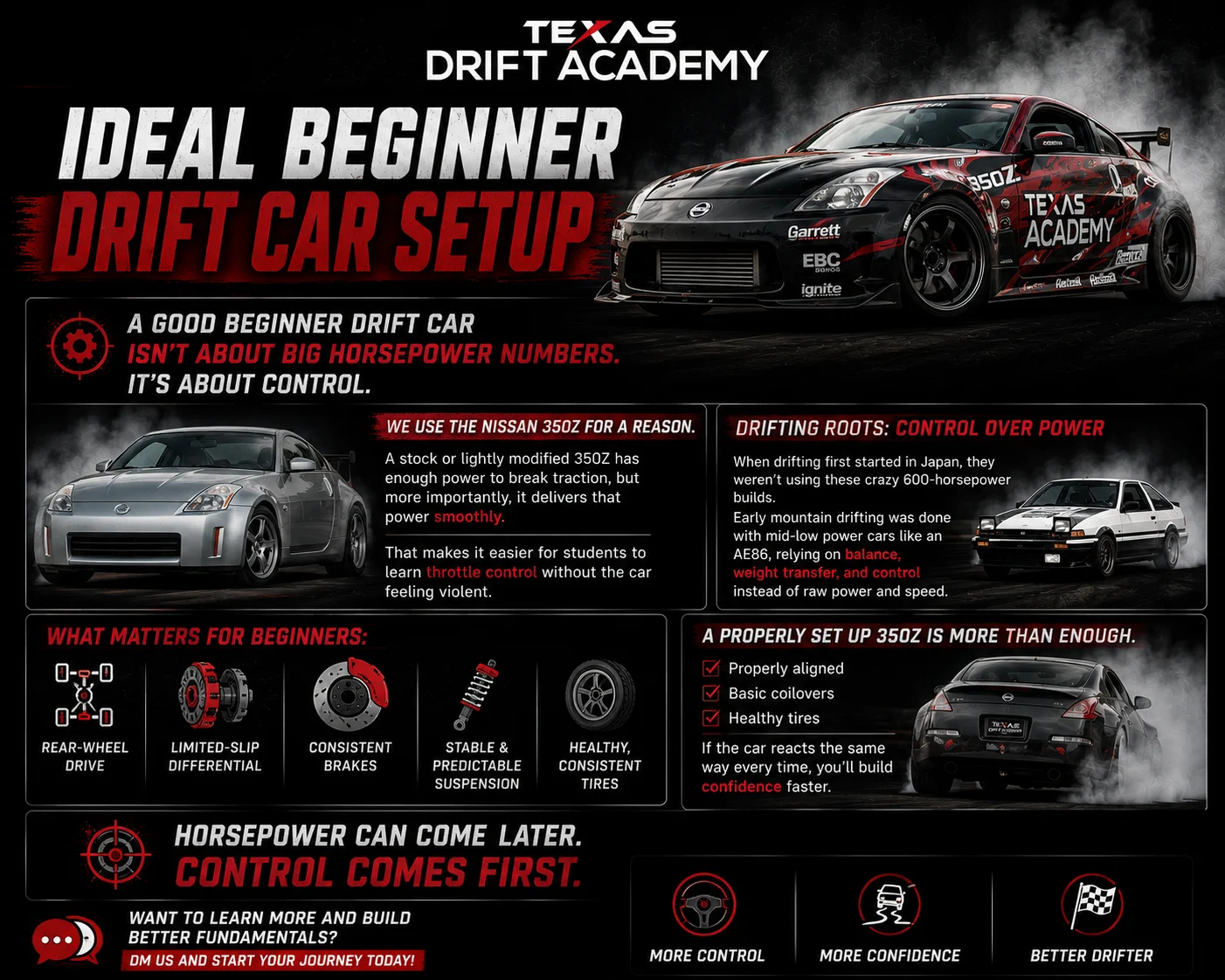
Ideal beginner drift car setup

A good beginner drift car isn’t about big horsepower numbers. It’s about control. We use the Nissan 350Z for a reason. A stock or lightly modified 350Z has enough power to break traction, but more importantly, it delivers that power smoothly. That makes it easier for students to learn throttle control without the car feeling violent. When drifting first started in Japan, they weren’t using these crazy 600-horsepower builds. Early mountain drifting was done with mid-low power cars like an [...]

By |2026-05-08T12:16:38-06:00May 8th, 2026|
Go to Top